
 Jules Samuel
You can’t spot fake followers from the outside. Not from the follower count, not from the profile, not from a glance at the grid. Every account with 40,000 followers looks the same as every other account with 40,000 followers.
What gives it away is what happens when you open ten of those followers and check them properly. Ten minutes, no tools, nothing but the app you already have.
This is the same audit a brand runs on a creator before it signs anything — the standard check in influencer marketing, on Instagram and every other social media platform. Six steps, then what to do with the answer.
Step 1 — Take a proper sample of the follower list
Tap the follower count. You’ll get a list, most recent first.
Don’t judge the first one you see. Every account on Instagram has some fake followers — they arrive unprompted, they follow profiles nobody paid them to follow, and finding one proves nothing. One fake follower is noise. You’re after the percentage, not a single account.
Open ten. Not one, not fifty. Ten is enough to see a pattern and quick enough that you’ll actually do it.
Take them from a few places in the list rather than the top ten in a row. Recent followers cluster — if a batch arrived together, the top of the list is all from the same batch, and you’ll either catch all of them or none. Scroll a way down, take a few, scroll further, take a few more.
Keep a rough tally as you go. You’re counting how many of the ten fail the checks below, not building a case against any single one.
Step 2 — Four signs of fake followers on a profile
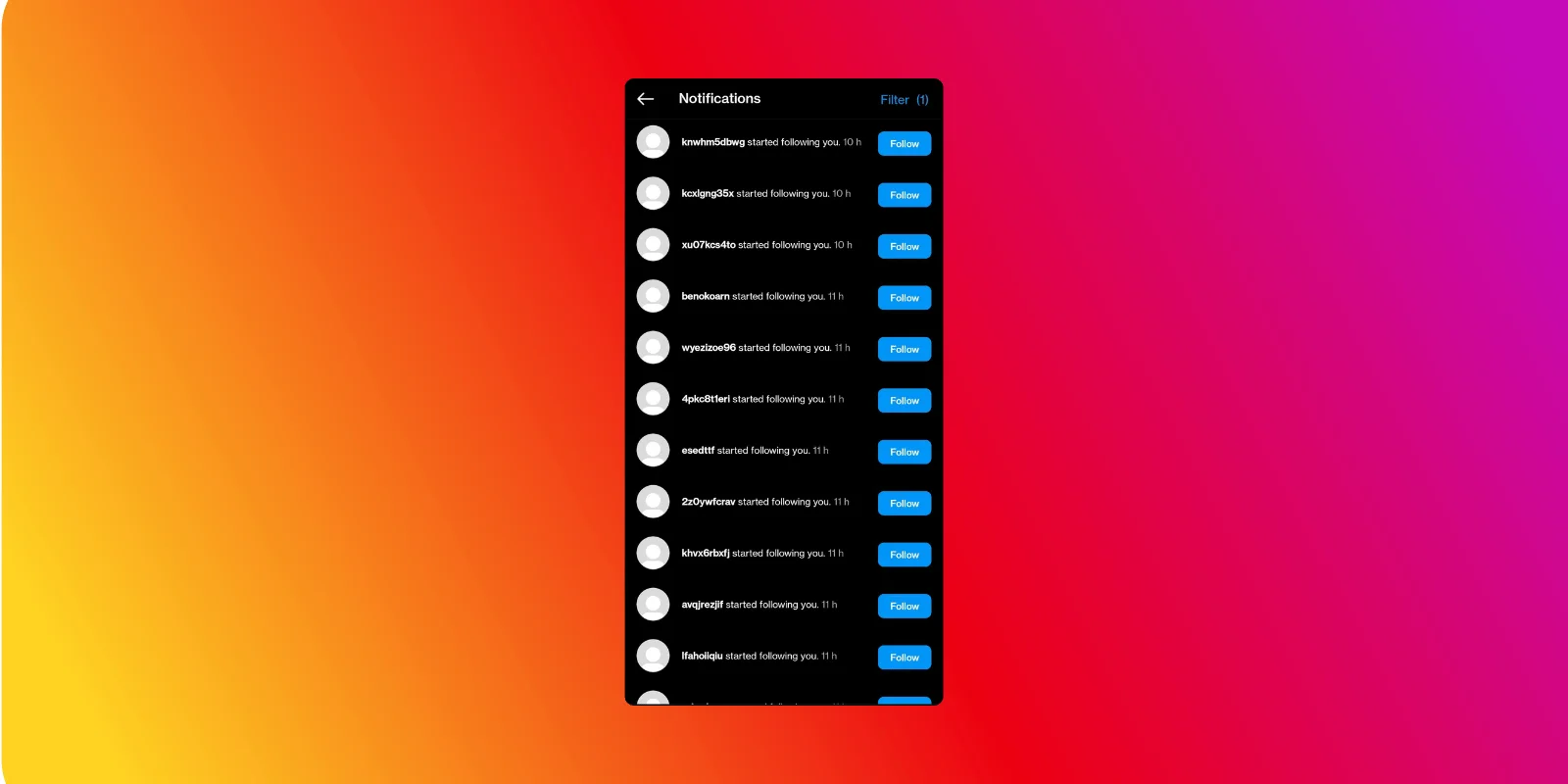
Open each profile and check four things. Twenty seconds each. These are the signs every fake follower check looks for, automated or not.
Posts against join date. An account created two years ago with zero posts isn’t shy. People who lurk still post occasionally — a holiday, a dog, something. Zero posts and a long history is an account that was made and never used. One is nothing. Six or seven out of ten is a delivery.
Following versus followers. A person follows a few hundred accounts and has roughly a few hundred back. The ratio moves around, but it stays in the same postcode. An account following 4,000 and followed by 20 is not a person with unusual taste — it’s an account whose job is following. That gap is the single most reliable tell on this list.
The profile itself. A picture that looks like a person took it. A name that reads like a name. A bio with a sentence in it. Or: default avatar, a handle like user_8817392 or maria.lopez4471, an empty bio. Trailing digits on a plausible name are worth noticing — real people pick handles, generators pick patterns.
When they joined. Harder to see, but if you can tell, look for clustering. Ten accounts that appeared within the same few weeks didn’t find the profile independently.
Where they are. Not a fifth check so much as a thing you’ll notice. If the content is in English and aimed at the US or UK, and the followers are overwhelmingly from one country with no plausible reason to be there, that’s the geography of a bot farm rather than an audience. Brazil, Indonesia and India come up constantly here because that’s where the cheap social media follower supply lives — but the tell isn’t the country, it’s the mismatch. A US fitness creator with a real Brazilian audience is a normal thing. A US fitness creator whose entire recent follower list is Brazilian is not.
None of these settles it alone. A real person can have no posts. A real person can have a bad handle. What tells you something is the percentage — how many of the ten fail, and how many checks each one fails.
Step 3 — Check the engagement rate against the follower count
This is the one that doesn’t depend on your judgement.
Add up the likes and comments on the last handful of posts. Divide by the follower count. Multiply by 100. That’s the engagement rate — the number every influencer marketing platform leads with, and the one metric here that doesn’t depend on your judgement. It’s the first thing a brand looks at and the last thing a creator can fake.
Now — and this is where most people get it wrong — the number means nothing without the account size.
Engagement rate falls as accounts grow. That’s not a sign of anything; it’s how the maths works. A small account’s followers mostly know them. A large account’s followers mostly don’t. So a rate that’s healthy at 200,000 followers would be dismal at 2,000.
Rough shape of it: small accounts run high, and the rate drops steadily as the count climbs. A big account sitting at a fraction of a percent is normal. A small account sitting at a fraction of a percent is not.
What you’re looking for is a rate that’s low for that size — a creator with 50,000 followers pulling 80 likes a post. That’s the mismatch, and it’s the single clearest sign of fake followers there is. The audience is on the profile and it isn’t watching.
Two things that muddy it, so don’t call it on this alone. Reels change the picture — an account whose reach comes from Reels can have a low rate on feed posts and be perfectly healthy. And a single viral post skews the average, so use a few posts, not the best one.
Step 4 — Read the comments, don’t count them
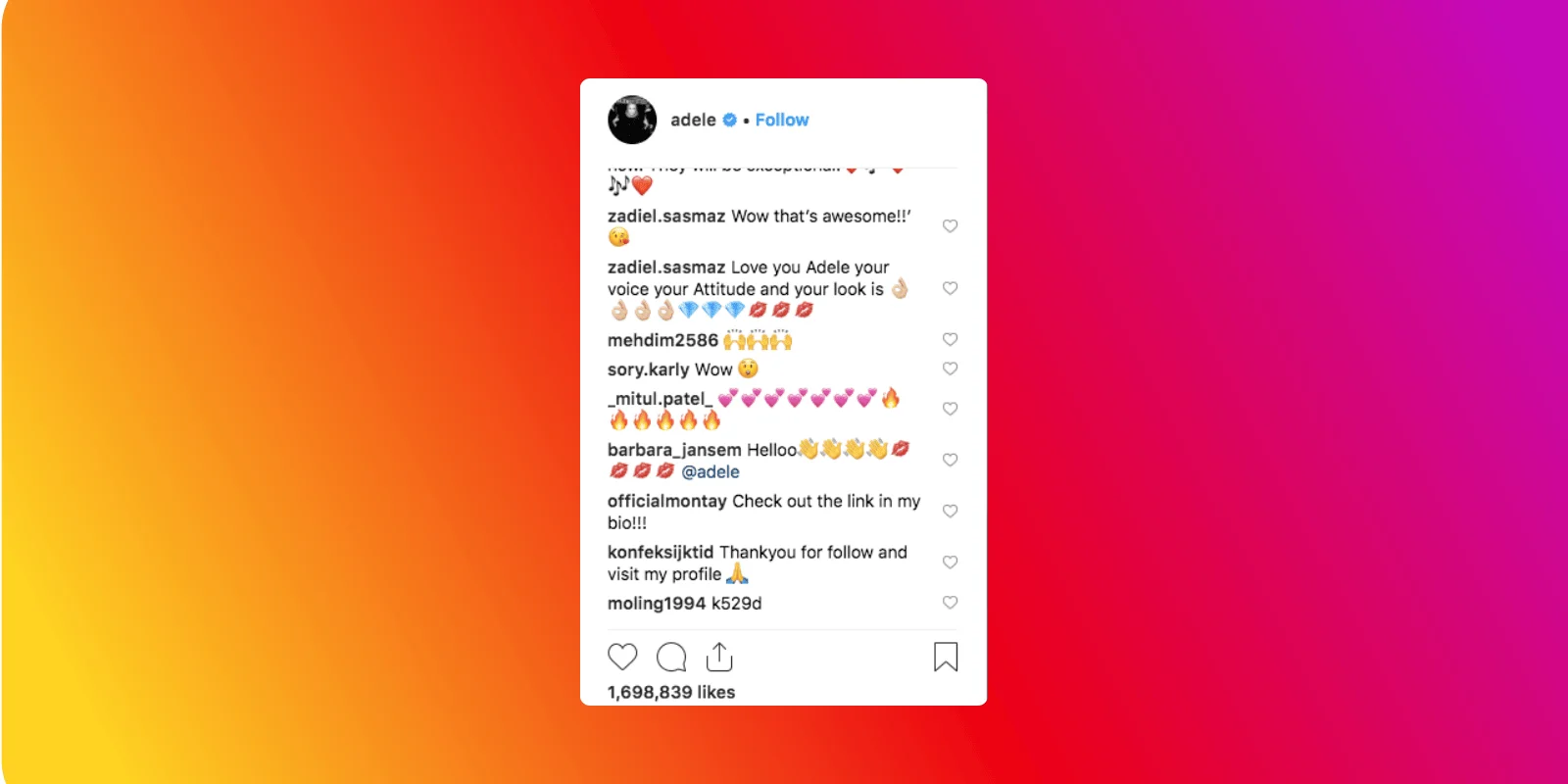
Open the last few posts and read the comments rather than counting them. Engagement rates can be gamed; comment quality is harder to fake.
You’re looking for comments that would fit under literally any post. “Nice!” “Great content!” “Love this 🔥”. Not because enthusiasm is suspicious — people do write short comments — but because a real comment is about the post. It mentions the thing in the photo. It answers the question in the caption. It argues.
Generic comments arriving in a cluster, from accounts that also failed Step 2, is the pattern. Any one of those three on its own isn’t.
The other tell is timing. Real comments trickle in over hours and days. A block of them landing in the same few minutes, days after the post went up, didn’t come from people scrolling.
Step 5 — What you can’t see: follower growth over time
Here’s where most articles about this tell you to watch for overnight follower spikes. That advice is useless on its own, because Instagram doesn’t show you follower history. Not for your account, not for anyone else’s. There’s no chart. There’s nothing to watch.
What you get natively:
- Your own account: Insights shows follower change over a limited recent window. Something, but short.
- Anyone else’s account: the current number. That’s it.
Third-party trackers and fake follower check tools — the same social media audit platforms brands use to vet influencers — fill the gap by recording the count regularly and building the history themselves. Most offer one free check before asking for money, which is enough for a single handle.
Two things worth knowing about them. They only have data from when they started tracking — look up a profile nobody’s ever checked and the history starts today. And they’re sampling, so a spike and a recovery between two samples can vanish entirely.
The audit tools that report a percentage of fake followers are running Step 2 at scale — same checks, more accounts. Useful, and worth knowing they’re not doing anything you can’t do by hand on ten profiles.
If you do get a chart, what you’re reading is the shape:
- Organic growth is a rising line with lumps in it. Posts that did well show as bumps. It goes up and to the right, unevenly.
- A delivery is a step. Flat, then a vertical move, then flat again — and it doesn’t line up with anything the account posted.
- A purge is a cliff. Instagram removes inauthentic accounts in waves, on its own schedule, and thousands go at once. Everyone loses some to this. A big vertical drop with no matching drama is a purge, and it tells you what those followers were.
The step-then-cliff pattern — sharp rise, no corresponding post, sharp fall weeks later — is about as close to proof as this gets.
Step 6 — What percentage of fake followers is normal?
You’ve got ten profiles, an engagement rate, a read on the comments, and maybe a chart. Now what.
The honest answer is that nobody has a clean number for this, and any tool that hands you a precise percentage is being more confident than the data allows. What you can read is the scale of it.
One or two out of ten: nothing. Every profile on Instagram carries some fake followers. They arrive on their own. Reading anything into this is how you get it wrong.
Three or four: still probably nothing, especially on a large account. Bots go where the numbers are, so bigger profiles collect more of them without doing anything.
Six or more failing multiple checks, plus an engagement rate that’s low for the size: that’s a purchase. Not one signal — the stack. The profiles, the maths and the comments all pointing the same way.
A step in the chart with no post behind it, followed by a cliff: that’s the strongest single piece of evidence available, and it’s the one you’re least likely to have.
What you can’t do is prove it. You’re reading a pattern, not finding a receipt. What you can say is that the follower count and the behaviour don’t match — and for a brand deciding whether to pay a creator, that’s the question anyway. No influencer gets asked to confess. They just don’t hear back.
That’s the audit. It’s what an influencer marketing platform automates and what a brand runs by hand when the deal is small enough — better tools, same six steps.
Which means if you’ve bought followers, this is what gets run on you. So run it on yourself first. And if you didn’t like the answer, the rest of this page is what to ask for next time.
What to ask a vendor before you order
Every check above has a question behind it. Whatever caught you is the thing you should have asked before you paid.
“Is it a burst or a drip — over what window?”
Defeats: Step 5, the step in the chart.
A bulk add is the shape that gives it away. Five hundred followers landing in one afternoon draws a vertical line on any chart that’s watching, and it lines up with nothing you posted.
A good answer sounds like: a window, in days, that scales with the size of the order. Small orders over hours, large orders over a week or more. Skweezer paces delivery across a campaign window for this reason — it’s not a feature so much as the obvious way to do it.
A bad answer sounds like: “instant.” Instant is the vendor telling you they’re optimising for the thing that gets you caught.
“Can you target where my audience is?”
Defeats: Step 2, the geography check.
If your content is in English and aimed at people in Manchester, and your new followers are overwhelmingly Brazilian, that gap is visible to anyone who opens ten of them. It’s also visible in your own Insights, which is worse — your audience data stops describing your audience, so every decision you make off it is now wrong.
A good answer sounds like: named markets. Skweezer offers USA and UK targeting, which covers most people reading this. If you’re aiming somewhere else, ask specifically rather than assuming, because most vendors’ targeting is thinner than their homepage suggests.
A bad answer sounds like: “worldwide” offered as a benefit rather than a default.
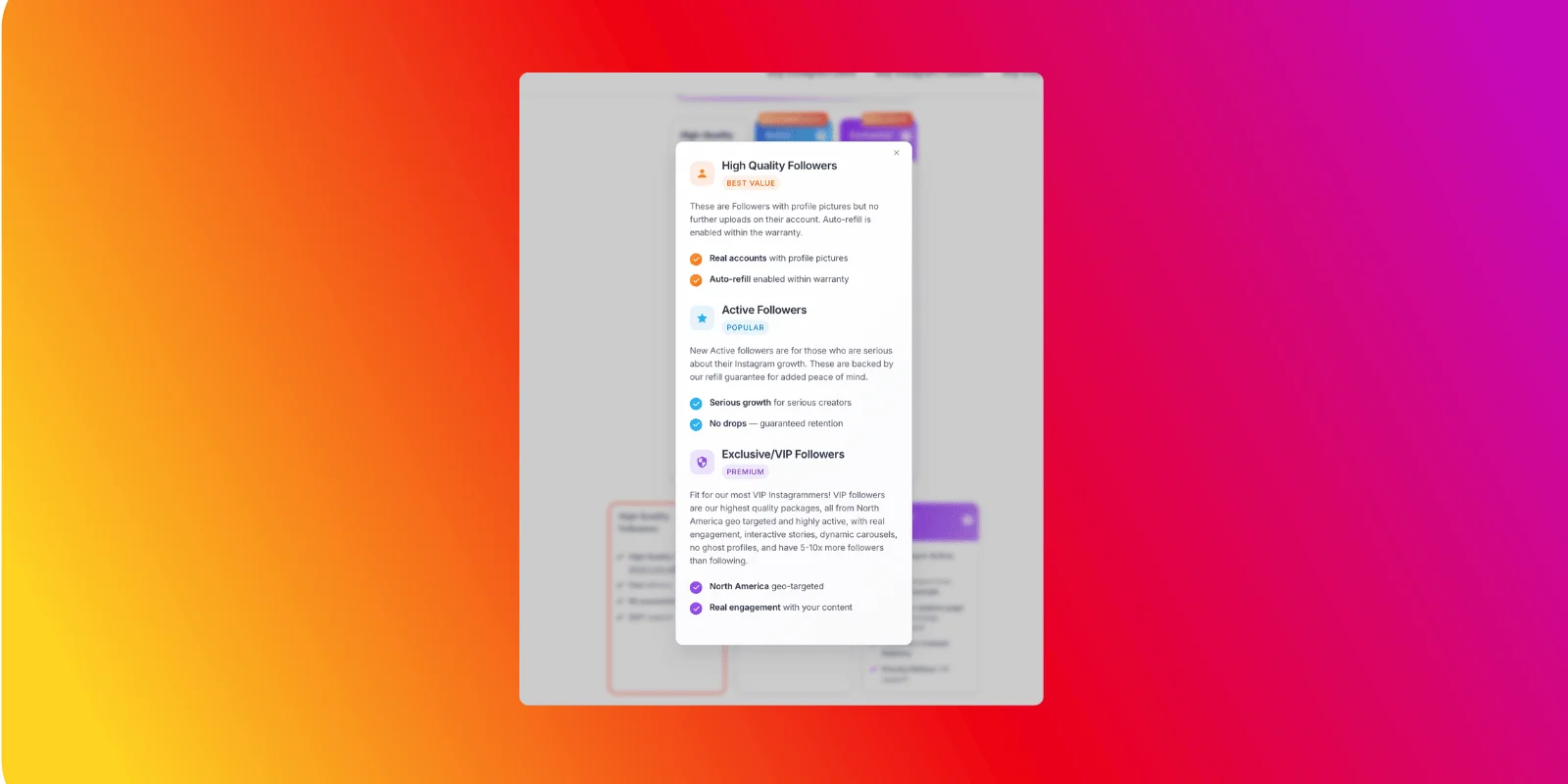
“Will they see my content, or just follow it?”
Defeats: Step 3, the engagement maths.
This is the one that costs you twice. Fake followers don’t just fail to engage — they sit in the denominator. Your engagement rate drops because the bottom of the fraction grew and the top didn’t, and reach follows the rate. You paid for a number that made the metric brands check look worse.
Here’s the honest version, and it’s not what you’ll read anywhere else: no vendor controls whether someone finds your content relevant. Including us. A real person in the right country who doesn’t care about your subject is a real follower who won’t watch your Reels. Relevance isn’t a thing that can be sold.
A good answer sounds like: a real mechanism, and a limit. Skweezer promotes profiles to an active community rather than assigning accounts to them, and makes every effort to put a profile in front of people likely to be interested — but doesn’t guarantee engagement, because nobody can.
A bad answer sounds like: guaranteed likes. That’s a promise about other people’s behaviour, and it’s not the vendor’s to make.
“Can I try it first?”
Defeats: all of the above.
Every other question on this list can be answered with a sentence, and a sentence costs the vendor nothing. This one can’t be talked around.
A free trial means you run Steps 1 through 6 on an actual delivery. Open ten of them. Check the ratio. Watch what the engagement rate does. See whether they’re still there in a month. That’s not the vendor’s claim about their followers — that’s the followers.
A good answer sounds like: a sample, no card, no email. Skweezer’s is on the free Instagram followers page — username, nothing else.
A bad answer sounds like: a trial that needs your password, a survey, or an app install. Whatever else that is, it isn’t a sample.
Run the checks on whatever arrives. That’s the whole point of a sample — not that it’s free, but that it’s evidence.